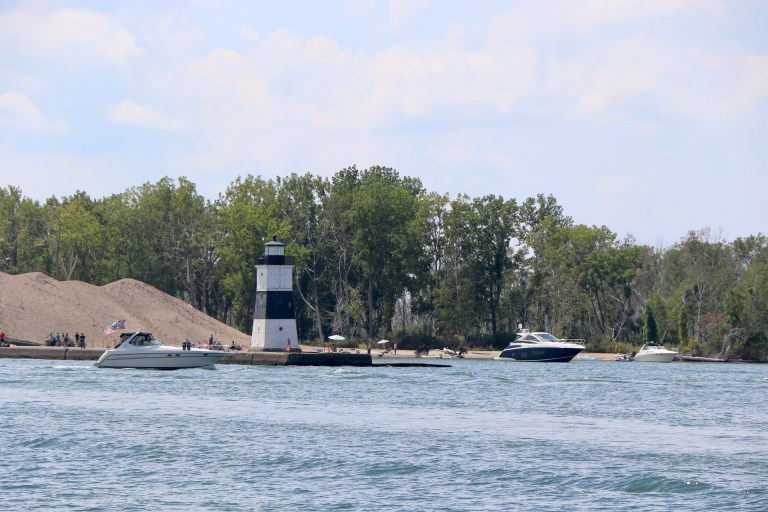
Toronto is no Kingston, bless its heart

Last time through Kingston we mostly focused on the miserable heat index and mosquito plague.  This year the weather allowed for a bit more, so like René-Bob de La Salle—the Frenchman who explored not only this area but also travelled the Mississippi River and founded Louisiana and thus simultaneously is responsible for delicious gumbo and, as we’ve previously noted, the societal abomination that is Ed Orgeron—we set out across Kingston on a mission of discovery.  Starting at Confederation Basin, where we could see Shoal Tower from our back porch.

Shoal Tower was part of a geographically-remote defense system related to the dispute over whether modern-day Washington state should or should not be on the American side of the border.  Several of these mini-forts—technically called Martello towers—dot the area but never saw action, undoubtedly because the British anticipated the emergence of grunge rock music in Seattle and decided they wanted no part of it.  But the towers look cool.

Across the river from the marina is Point Frederick, which was home to a primary British naval base during and after the War of 1812.  Now it’s home to the Royal Military College, where we walked through the imposing pedestrian entrance. 

The campus is cool and all, with a much friendlier vibe than, say, West Point.

That said, we still can’t wrap our heads around the fact that Canadians—with their unrelenting politeness and Tim Hortons and back bacon and disgusting poutine—somehow remain subject to the snooty British monarchy.

Fort Henry sits along the Lake Ontario shoreline with a nice view of Point Frederick, which is helpful since its main purpose was to protect the naval base.

Because there’s no need to protect the Royal Military College—and  because two-hundred-year-old cannons that lob aerodynamically awkward metal balls likely wouldn’t scare a modern enemy of the Crown—it’s just a museum now.   With a secret cannon burial ground that we found by sneaking back to the employee entrance.

Most interesting—and confusing—is that Fort Henry still proudly flys the Union Jack.

Back closer to Tumbleweed we passed the plaque for Fort Frontenac.

This French outpost, used during skirmishes with British and Iroquois, would date back to 1673 except there’s nothing left of it.

Not far from there but a hundred years later, the British “purchased from the Mississaugas for some clothing, ammunition and coloured cloth a large tract of land” that now encompasses a huge amount of valuable Lake Ontario waterfront property.

One might feel sorry for the Mississaugas for the raw deal, except they apparently decided to rely on a Zillow valuation rather than get a real appraisal, so had to live with it.  Plus they probably looked very sharp at the powwows in their fancy colorful clothes.

The coolest building in Kingston has to be City Hall, one of the zillion National Historic Sites we’ve been lucky to see.  We had no business to conduct with the city so didn’t go in.

Perhaps confirming our shallowness, all it took for us to reevaluate our view of Kingston was better weather.  We were able to walk around, see the sights, enjoy what TripAdvisor identified as the two best restaurants in town, and play some pickleball.

The city even compensates for the lack useable Wi-Fi by scattering colorful—which loosely translates to “colourful” in this British Commonwealth—muskoka chairs all about.

The bottom line is that we’ve completely changed our opinions, with Ottawa now dropping to the bottom of our list of favorite—which apparently means “favourite” up here—Canadian cities.  That’s even despite the rain that set in on Monday.

Actually the rain nearly was a blessing, because it provided a second opportunity to find a theater—which these pseudo-Brits call a “theatre”—showing Top Gun: Maverick.  This time it wasn’t in French.  However, after getting online tickets we concluded the rain was too much to overcome.  Strike two.

Tuesday morning was windy, but either our tolerance has increased or our good judgment has decreased so we headed off on the long trip to Trenton.  Long days underway are tough for eating.  One of us ate a banana for for breakfast.  One of us enjoyed Mountain Dew and Doritos for breakfast.*  But at least it wasn’t raining.  In fact, it was gorgeous even with the wind.

Back past the bird island, from which the wind blew double-crested cormorant stench right into our pilothouse.  Yuck.

Through the zig-zaggy Bay of Quinte.  Back past Mallory Bay and Shannonville, named for our awesome daughters.  Past the ferries.  A windy day on the bay means every clown with a sailboat feels entitled—if not obligated—to get in our way.  At least this guy made up for it by having a quite pleasing colourful sail for us to admire.

Then on into Trenton, where the AGLCA harbor hosts aboard Tropical Horizons II photo-documented our arrival.

Wait, did someone say Trenton?  Trenton is the “Gateway to the Trent-Severn Waterway.”  We’re not doing the Trent-Severn again.  So what the hell are we doing in Trenton?

The plan was to go from Kingston to Cobourg to Toronto, where Dana needed to catch a plane for a quick trip to Austin for her mother’s birthday celebration.  Happy Birthday Linda!  Except Toronto sucks for transients with large power boats.  So we had to find a place where she could catch a train to Toronto.  And we didn’t want to stay in Kingston.  So by default, we ended up back at Trent-Port Marina, which is a-okay by us because it’s solid joint in a solid town, even if (1) we fully explored Trenton during our extended stay four years ago and (2) the weather just turned hot and humid.

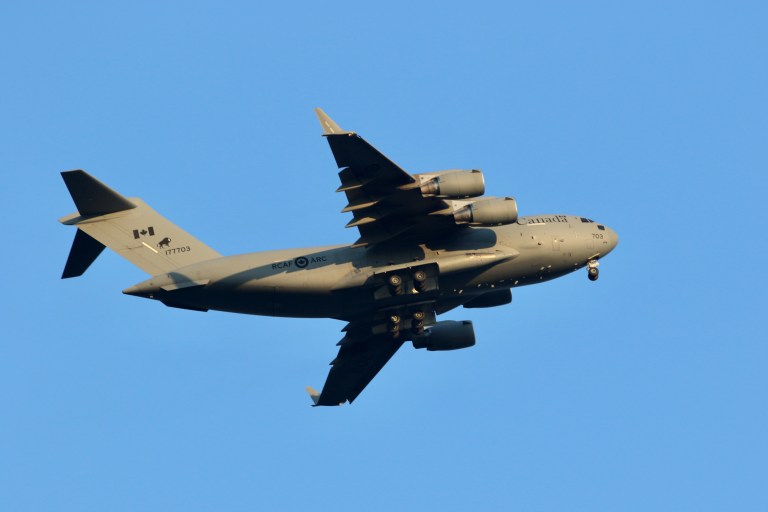
Trenton is home to the largest Royal Canadian Air Force base.

Given the location, however, it’s not surprising that CFB Trenton mostly is used to support military efforts elsewhere.  Which explains the Boeing C-17 Globemasters hauling stuff right over us every day.
Otherwise Trenton is a nice quiet town.  Unless you’re staging for the waterway, there’s not too much going on.  Except for that one weekend, that glorious first weekend every May, when it’s walleye-to-walleye excitement.

Incidentally, some skeptics might think the commentary about Canadian goose poop in our last post was exaggerated.  It wasn’t.

On Wednesday, Dana caught the train from Trenton to Toronto at Trenton Junction.**

In the course of two days her trip required planes, trains, and automobiles, but also a boat and a shuttle bus, unintentionally two-upping Neal Page in the process.***  Doug stayed behind with a fun and exciting list of boat chores, some of which actually got done.

On Sunday, Doug also boarded the train to Toronto at The Junction.****  The wait for Dana to return from Texas provided a golden opportunity to spends a few hours at Le Temple de la Renommée du Hockey.  The Hockey Hall of Fame.  The epicenter of the most Canadian thing in the world other than maybe poutine and goose poop.  The special exhibit “9 & 99” is awesome but the entire place really is extra cool, even for someone who considers hockey a distant fourth in major sports, just ahead of cricket.

The other most Canadian thing is putting a Tim Hortons next to the Temple.

Horton—whose actual name was Miles—is a Hall of Famer and all, but every experience we’ve ever had at one of his namesake restaurants has ended with self-recriminations for being stupid.  No offense to our Canadian friends, but Tim Hortons are as gross as something so gross you’d use it in a really exaggerated simile.

Now some other Toronto stuff.  Like the Old City Hall.

According to Wikipedia, when the thing was completed in 1899 it was “the largest civic building in North America.”  We’re dubious.  Because it doesn’t look nearly as large as, say, the U.S. Capitol Building.  It’s possible that we’re wrong, of course.  It’s also possible that some Tim Hortons-loving Canadian fudged the Wikipedia page.  Either way, it’s another of the cool old buildings we like to admire.

But here’s the sad truth.  Toronto looks like a fun city to live in, but overall it’s not that great for tourists looking for historical stuff.  In part that’s because—unlike the good people of Montreal and Quebec City who built their buildings out of brick—the folks in Toronto apparently never learned what happened to the Three Little Pigs.  Thus they built almost everything with sticks.  Which is why virtually the entire city burned down in 1849.  Then they rebuilt, again with sticks.  Which is why virtually the entire city burned down again in 1904.  So there aren’t that many old buildings to be visited by tourists like us.

Toronto may not have much left of historical significance, but that’s not to say we found little of interest.  For example, we’ve now referenced the under-appreciated classic Strange Brew in more than one post.  Elsinore Castle?  Filmed at Casa Loma.  We’re ashamed to admit that we didn’t visit the mansion—which the government stole from the owner, then used for secret war research, then leased as a Kiwanis clubhouse—but we did get sort of a photo from afar.

Also, Toronto is quite proud of its major university, which indeed is internationally renowned.  Not surprisingly, we have thoughts.  For starters, the University of Toronto has a gorgeous campus.
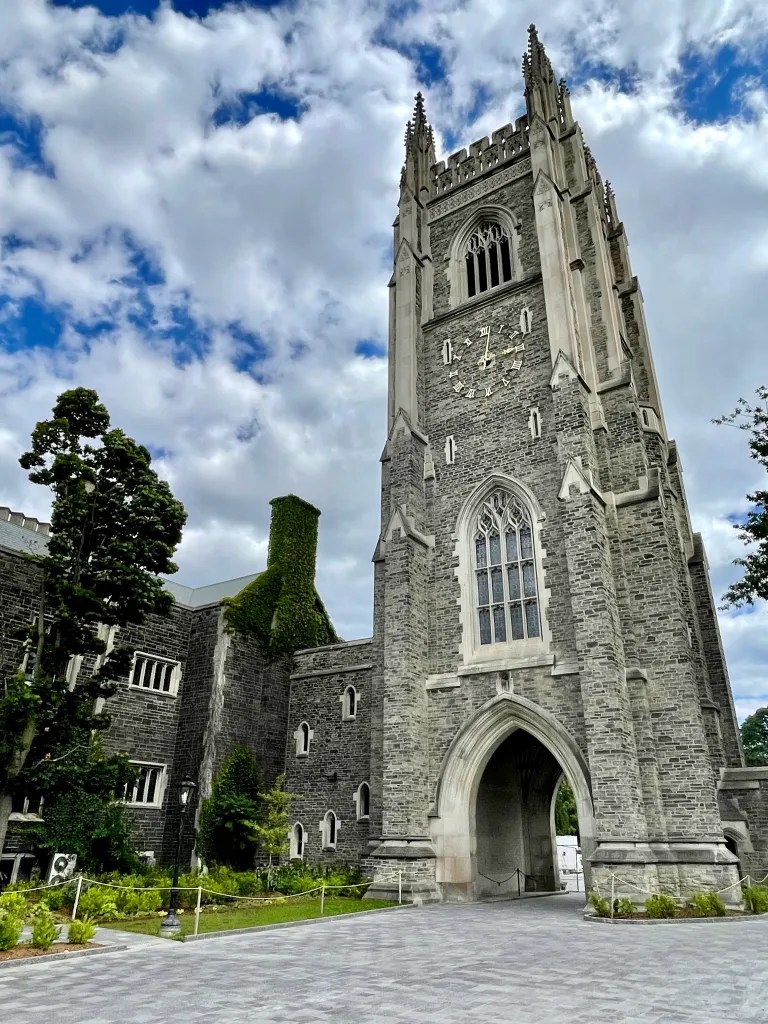
Which is why it’s also been used in a lot of movies.  Cocktail brought Tom Cruise up here.  Matt Damon was a math genius up here.  Lindsey Lohan became a Mean Girl at U of T as they call it, after she met herself at Camp Walden and got her parents back together by driving off evil Meredith Blake, but before she went all drunk and crazy.

Now about this “U of T” thing, which sounds enough like UT to startle us when we heard it.  We both agree that there’s only one real UT, although we don’t agree on which one it is.  But we know for damn sure the real UT ain’t the University of Toronto.  Adding insult to injury, the Varsity Blues even use a bastardized version of the Power T.  Somebody needs to be flogged and burned at the stake for that travesty.

We didn’t visit the provincial art gallery, but out front they did have a bizarre elephant, made of leather bags, standing on a brass ball.  We don’t get it.

Also murals.  Lots of murals.  This one is on the wide end of Toronto’s Flatiron Building, which supposedly has the most coveted office space in town.

Over at the Rogers Centre—which is Canadian for “Rogers Center”—a huge sculpture of Blue Jay fans in action is even more odd than a leather elephant balanced on a ball.

The Rogers Centre is at the base of the iconic Canadian National Tower, so named because the Canadian National Railway Company built it.

CN Tower is really tall, and it takes much more effort to go up and take a photo of downtown than, say, it would take to get the same photo by drone if there wasn’t a geofence around the city.  But we went up, because we’re tourists.  Turns out the effort was well worth it.

A few more things.  The Museum of Illusions was kind of interesting.  We participated.

The greatest illusion, however, was the one where fifty screaming snot-nosed kids in yellow camp shirts were supposed to disappear but then the counselors who were busy looking at Instagram on their phones decided to let the kids stay and run wild during our entire visit.

National Geographic says the St. Lawrence Market is the world’s best.  So of course we went.
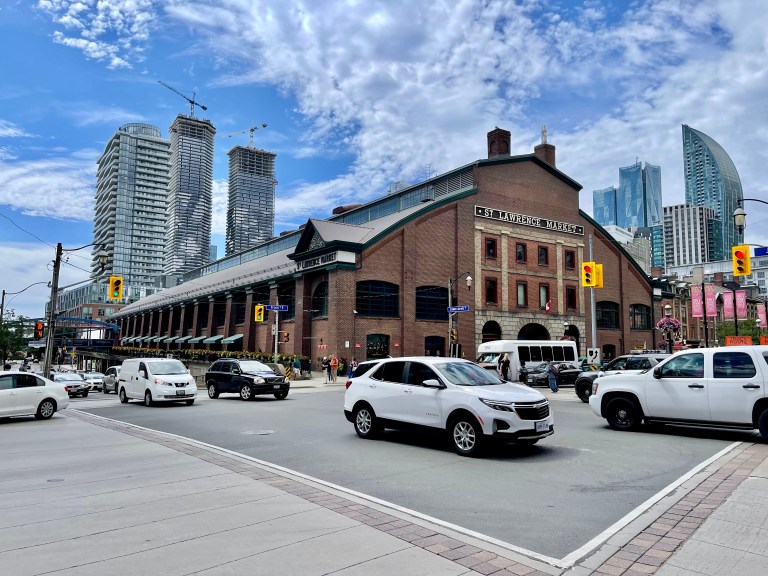
Meh.  It’s huge and fine and all, but we’ll take the Jean-Talon Market in Montreal instead please.

So that about sums up Toronto, a nice city that saw most of its history burn down and thus clings to stuff of barely-marginal significance.

With that said, we’re glad we stopped by.

This afternoon’s train took us from Toronto’s Union Station back to Trenton and Tumbleweed.  Tomorrow we continue our counter-clockwise journey around Lake Ontario as we head towards new stuff on Lake Erie.

——————

*“Junk food doesn’t deserve the bad rap that it gets.  Take these pork rinds for example.  This particular brand contains 2% of the R.D.A.—that’s ‘recommended daily allowance’—of Riboflavin.”
— Walter “Gib” Gibson

** Everybody sing along!  “Come ride the little train that is rollin’ down the tracks to the junction.”

***And there you have it: a single paragraph that, with footnotes included, seamlessly weaves together oblique references to a movie starring famous Ontarian John Candy and Petticoat Junction.  That’s got to be a first.

****“There’s a little hotel called the Shady Rest at the junction.”

You did NOT complete the Trent-Severn Waterway, or Who the hell enjoys EDM?

The vast majority of Loopers cruise the fabulous Trent-Severn Waterway through an awesome little piece of Ontario.  Generally they start in Trenton and end in Port Severn and then tell all their friends that they ran the entirety of it.  Hell, until two weeks ago we were two of those sadly mistaken Loopers who told our friends that we’d done the entirety of it.  False.  Because there’s a six-mile stretch of canal between the Bay of Quinte and Lake Ontario that only a very small subset of weirdo Loopers—i.e., those who aren’t heading to Port Severn but still go out of their way to Trenton anyway because someone has to catch a plane in Toronto and realized too late that there’s no place to dock in Toronto so needed to find a train station—would have any reason to transit.

So NOW we’ve done the whole thing.

And it was pretty cool, except for the pushy dude in the little SeaRay who unsuccessfully tried to bully and then deceive the Carrying Place Bridge bridgemaster into letting him through without us, even though we were only a few minutes behind.  That dipshit was not cool.

The Brighton Road Bridge bridgemaster doubles as the Brighton Road Bridge toll-collector, because everyone who wants to brag about doing the entire Trent-Severn Waterway—or who just wants to take a shortcut home—has to put their $5.25 in the cup as they pass by.

Except us.  We foiled the nice lady with the cup by showing our Parcs Canada season pass, and felt very accomplished by doing so.

Then on out into Lake Ontario, where not even a gazillion non-photogenic birds could interrupt a great day for traveling.

Cobourg—where we stopped for two nights—is known as “the gem of Lake Ontario,” at least to the good people of Cobourg.  We won’t argue.  Cobourg is right up there with some of our favorite stops.  Cobourg has everything.

Cobourg has a nice little marina.  Sheltered harbor.  Deep water.  No weeds.

Cobourg Harbour also once was home to an America’s Cup challenger, although we concede that would be far more impressive had it occurred more recently than 1876.

Cobourg has a beach, which the locals say gets clogged with Toronto riff-raff on the weekends but looked pleasant enough during our stay.

Cobourg has a small downtown filled with delicious restaurants we both enjoyed, and cool little shops—including a treasure-filled bookstore—that Dana enjoyed alone while Doug did important stuff that didn’t involve little shops.  Heck, they even timed the street market to coincide with our visit.  That never happens.

Cobourg has a stately old building.  Victoria Hall serves as both the town hall and a live performance venue that next month is featuring a musical about that precocious troublemaker Matilda.

Cobourg has an iconic statue, although it’s not labeled and our waitress drew a blank despite living in Cobourg for six years.  Even an exhaustive five-minute internet search whilst waiting for our tacos yielded no explanation for it.  We still like the dude.

Cobourg has a remarkably-niche museum featuring Canadian female film trailblazers from a century ago, a full 33.3% of whom we recognized.  By name only, of course, because the place was closed so we couldn’t see any photos.

Cobourg has this contraption, which is as mysterious as the statue but will come in way more handy if the future is anything remotely Mad Max-like.

But, some might ask, what about pickleball?  Yup.  Indoor and outdoor courts.

So even though we’d be the only Americans in town, basically we’d move to Cobourg except (1) our thirty years of physiological Arizona conditioning means that at about 55° our blood turns the viscosity of cured concrete, and (2) it’s against the law for Canadians to sell or rent homes to people with our well-documented opinion of poutine.  But dang, Cobourg is a great place to visit.

By leave-the-dock time Friday morning, the fog that first rolled over Lake Ontario Wednesday afternoon was gone, which is a good thing, because we’re a tad fuzzy on the appropriate horn sequence when traveling through it.  Crystal clear day all the way to Whitby.

And by golly we needed to get to Whitby.  Because there’s a Home Depot relatively near the marina and Doug dismantled the galley faucet on Thursday only to find that the replacement assembly he bought needed adaptors and profanity.

The only real excitement on the trip was when the Canadian Coast Guard started asking folks to help a boat on fire in Lake Erie, when Red Devil hustled to help rescue two paddle boarders but was aced out by some unnamed interloper, and when Kenny reported that ten-year-old Cole had just caught his first salmon.  A 28 pounder, which is a big fish no matter how old you are.   About an hour after the south wind started driving three- and four-foot Lake Ontario waves into our port side, we ducked into Port Whitby.

Whitby really was just a functional stop, not an exploration stop.  Which is a good thing because Port Whitby is a boatyard without much around.  On our gritty Home Depot walk we passed by the Whitby Rail Maintenance Facility, however, so we now know where passenger cars are painted.  Which isn’t much but it’s something.

Saturday brought another long travel day, this time to the industrial city of Hamilton.  We know what people in the rest of Ontario think about Hamilton, because every time we mentioned we were going there, they invariably said “Why would you go to Hamilton?  Hamilton sucks.”  By the time we heard that enough times for it to sink in, however, we’d already paid the non-refundable dockage fee.  Oh well, throw on some George Strait and let’s go.

No radio drama on the trip across the west end of Lake Ontario.   Nobody reported a crisis.  Nobody reported a fish.  Beautiful weather.  Smooth water.  About the only thing of significance was passing Toronto.

At 1,815 feet the The CN Tower was the world’s tallest tower for a bunch of years.  There’s an annual fundraiser that involves racing up 1776 steps to the main observation deck.  The record is just under eight minutes.  That’s just absurd.  Because we had limited time when we went up a few days ago, we decided to save seven minutes by taking the high-speed elevator with the other schlubs.

Canada’s busiest commercial seaport is in Hamilton, protected by the Burlington Canal Lift Bridge.

Just before the bridge we passed Hamilton Beach.  Which would’ve been great if we needed a crockpot or a toaster oven.

Since we didn’t need any kitchen appliances we went on under the bridge with a zillion other boats.

Hamilton being an important seaport and all, big ships were scattered about the bay amongst the sailboats.

The HMCS Haida—which Parcs Canada touts as “the Royal Canadian Navy’s most famous ship”—is a decommissioned destroyer operating as a museum around the corner from Harbour West Marina.  She sank more WWII surface tonnage than any other Canadian warship.  Since Hamilton also mostly was a one-night pit stop we took a picture on the way by but didn’t go visit.

There’s not much within walking distance of the marina, but we did stop at a convenience store run by a guy from England.  Turns out he loves and carries Dana’s favorite chocolate, which is hard to find on this side of the Atlantic.  He had 25 of them in stock.  Dana bought them all.

The Hamilton highlight was when John and Jenn from Salty Rose stopped by with margaritas.  Great folks.  Not Loopers.  The Hamilton lowlight was the God-awful electronic dance “music” from the rave at the park with the Canadian flag about two hundred feet off our stern.  It was thumping when we arrived at 3 and thumped nonstop until nearly midnight.  But hey, the marina is nice enough.

After her morning run, Dana reported that in fact the non-industrial bits of Hamilton are far more enjoyable than the naysayers led us to anticipate.  But right now we’re on our way to Fifty Point Conservation Area, which promises to be a tad more scenic and quiet.

Hamilton wins, by Fifty Points

The Port of Hamilton apparently was such a polluter that someone felt guilty and created the Hamilton Conservation Authority, which in turn created the Fifty Point Conservation Area, with trails, bird-watching platforms, campsites, and a marina.  We’re damn glad they did, because Fifty Point Marina is awesome.  Like on our short list of all-time stops kind of awesome.

Perfect weather to boot.  Cool enough to sit on the bow and watch folks go in and out as the sun went down.

The marina restaurant—which got horrible reviews—turned out to be excellent.  New ownership.  Never trust what some anonymous clown posted ten years ago.

Then off to the wineries.  The Niagara region claims to produce “exquisite wines,” so we hiked along the busy sidewalkless highways until we reached a couple of the local joints.

Meh.  Not worth the walk.

Fifty Point also is home to a couple of beaches, which attracted roughly a zillion beach goers over the holiday weekend.  Asaad the Uber driver wasn’t thrilled about being stuck in the long line of cars waiting at the pay station, but we still won because we didn’t walk home.

Did we mention that Fifty Point is a big birding area?  Not Big Bird, of course, but a variety of species stop by to “feed and loaf.”  That’s what the sign actually says.  The birds “feed and loaf.”  The author of the sign perhaps learned a thing or two from Brian of Nazareth.*  Dana snuck up on a family of barn swallows who indeed weren’t being very productive.

Monday morning we beat the crowd out to one of the beaches, just to check it out.  We see the attraction.  Soft waves.  Cool water.  And the delightful squish of warm goose poop between your toes.

All in all, a near perfect stop.  We were a bit concerned when they pulled a disabled vintage Bayliner up behind us—what with the gasoline that had pooled in it and all—but surprisingly it didn’t explode before we left so then we stopped worrying.

Yesterday we took the short hop to Port Dalhousie, where we’re staging for the Welland Canal.   Hey, what the heck are all these yellow markers doing out here in our way?

Up there someplace on shore is a Canadian military training facility, where real bullets sometimes fly out into that odd area.  We may have cut through one corner of it but nobody shot us, so it was okay.

Based on the cutesy and welcoming old-fashioned town sign, one reasonably might expect Port Dalhousie Pier Marina to be cutesy and welcoming.

Not a chance.  The two women running the place are so markedly unhelpful and impolite that we’re sure they aren’t Canadian.  But we sucked it up.  The reviews for the marina restaurant weren’t too bad.  Riiiight.  An abandoned hulk of what once was a restaurant but now is sinking into the muck doesn’t work for us.  As a wise blogger once said a few paragraphs ago, never trust what some anonymous clown posted ten years ago.

Much like Fifty Point has a beautiful forest, Port Dalhousie has a forest, which we can enjoy right off our stern.  Except this one is underwater.  Barely.  Hopefully we can get out tomorrow without a chainsaw, because we don’t have one aboard.

The marina may suck, but the town is kind of charming.

In addition to a carousel so iconic that it made the welcome sign, there’s a tree with undoubtedly the most bizarre trunk we’ve seen.

More importantly to our status as tourists, we’re only a twenty-minute Uber ride from Niagara Falls.  Which makes sense, because the Welland Canal’s entire purpose in life is to help commercial shipping companies avoid the logistics of portaging millions of gross tons along the Niagara River.

Wooooo!  Yet another opportunity for a line from “The Wreck of the Edmund Fitzgerald,” because in fact Lake Ontario “takes in what Lake Erie can send her.”  Which again is one of those confounding things, since everyone knows water flows down and down is south.  Regardless, all that Lake Erie water flows north over the falls at about 5.9 million cubic feet per minute, which sounds and looks like a lot but then we calculated it would take around thirty months at that rate to fill Lake Powell.

After we arrived, a nice boy with two extra boat-ride tickets invited us to join his family for a discounted price.  They even motioned for us to be in the family photo, but we demurred.  True story.

Anyway, Niagara Falls in fact is quite a spectacle, even on a gloomy day.

We’ve provisioned, inflated the big boy fenders, sized up an exit path through the weeds, and are ready to leave Lake Ontario.  Hopefully by tomorrow evening we’ll be on Lake Erie.

——————

*BRIAN: [Consider] the birds, then.

EDDIE: What birds?

BRIAN: Any birds.

EDDIE: Why?

BRIAN: Well, have they got jobs?

ARTHUR: Who?

BRIAN: The birds.

EDDIE: Have the birds got jobs?!

FRANK: What’s the matter with him?

ARTHUR: He says the birds are scrounging.

BRIAN: Oh, uhh, no, the point is the birds. They do all right. Don’t they?

FRANK: Well, good luck to ’em.

EDDIE: Yeah. They’re very pretty.

BRIAN: Okay, and you’re much more important than they are, right? So, what are you worrying about? There you are. See?

EDDIE: I’m worrying about what you’ve got against birds.

All’s Welland that ends Welland

As a general proposition summer sunrises in Canada suck, because they occur well before normal people are awake.  But at least they don’t discriminate against crappy marinas, so we got to watch one yesterday when we headed off towards the fearsome Welland Canal.  To borrow from Cotton McKnight—one of the greatest sportscasters in ESPN 8 history—the Welland “separates the wheat from the chaff, the men from the boys, the awkwardly feminine from the possibly Canadian.”*

Moments after untying, we immediately noticed a complete lack of steering.  Hmmmm.  This isn’t good.  Locks without steering seems kind of dangerous.  Fortunately a few fits and starts and reverses later the rudder disgorged all the weeds and order was restored by the time we tied up at the pleasure craft waiting dock behind Foolish Dream.

Erin was surprised to learn that she couldn’t tow her dinghy through one of the world’s largest commercial seaways, but with some pluck and Dana’s help she hauled it aboard.  Doug and Brian sat on Tumbleweed and clucked, Brian being the experienced dude we hired to satisfy the three-person crew requirement.

The cargo ship that threatened to slow us down mercifully stopped before Lock 1, so off we went at 9:00.  Here’s the thing.  The Welland Canal southbound takes boats 326 feet up to Lake Erie.  Eight locks, although because as discussed below Lock 8 doesn’t really count, the first seven average 47 feet of lift.   These aren’t those friendly little locks where cheerful college kids chat endearingly while you go up or down a few feet.  They aren’t the biggest we’ve seen, but given the surface area it takes a long time to fill these monsters.

All whilst Dana and Brian held crappy polypropylene lines that the lock guys threw down.  The same lock guys run from lock to lock to throw those crappy lines down.  One of our guys coincidentally was named Guy.

What really must suck is trying to hold a 740-foot ship carrying 28-thousand tons of widgets using a 3/8-inch slippery line.  So instead someone invented automated suction cups that clamp and center the big boys in the locks.  Way cool.

A few miles in we met our first ever double flight of locks, meaning two flights of three, going opposite directions.  By the time we popped out the top we essentially had scaled Niagara Falls, ten miles to the east.

This canal is such a spectacle that they actually built a spectator platform.  We waved to the nice people on our way by.

After Lock 7 we dropped Brian off a few miles from his house.  Great guy.  Knew all the tricks.  Huge help.

Did we mention that the Welland is a commercial waterway?

But this isn’t a just photo of us passing Baie St. Paul.  It’s mostly a distant photo of Bridge 11, also known as the Allenburg Bridge.  The Allenburg Bridge is famous because of that time in 2001 when the bulk carrier Windoc smashed into it.  Turned out the bridge operator was drunk and lowered the bridge just in time to shear off the aft high stuff, including the pilothouse and smokestack.**

Amazingly nobody was hurt and despite a fire that took a while to extinguish, no fuel or oil escaped.  Presumably the bridge operator didn’t escape but we couldn’t find any info about what happened to him.

A bit further south and a bit more recently, in 2020 the Alanis and the Florence Spirit rammed each other head on, which frankly seems impossible in the era of, you know, VHF radios.  We start talking to these boats in plenty of time to learn their intentions, for the express purpose of preventing Tumbleweed from becoming a hood ornament.  A game of chicken seems quite foolish indeed.

Wait a second here!  What the hell is a pontoon boat doing in the lock-protected seaway?

This actually is the Port Robinson Ferry, which takes passengers across the canal.  In the old days, the Port Robinson Bridge served the same purpose, with the added advantage of carrying car traffic.  But then in 1974 the cargo ship Steelton hit the bridge as it was lifting.

Our man Brian actually was on the scene and showed us a bunch of pictures he took.  Anyway, the people in charge apparently concluded that a small pontoon boat would serve the Port Robinson populace as well as any bridge, so now there’s not one.

Shortly before Lock 8, the Redhead sits in a confusing set of logistical decisions.  She dropped a load with no contracts for return cargo, so apparently has been waiting for weeks in Port Colborne with her fingers crossed, which doesn’t sound like a profitable strategy.

As for Lock 8?  Easy way to finish a long day.  Our first float-through lock since Nova Scotia’s Canso Canal three years ago.  Nice.

The lock dudes said we did the fastest passage of the year so far.  We’ll take it.

At the same time, we left Port Dalhousie at 6:45 a.m and hooked into Sugarloaf Harbour Marina in Port Colborne at 5:45 p.m., with not much relaxing along the way.

The totem pole with the hand-painted driftwood says we’re about 60 nautical miles from Erie.  Pennsylvania.  USA.  Unlimited high-speed data.  However, the predictors of such things say Lake Erie will be blessed with high winds and big waves until Saturday.  So we ain’t leaving before Saturday.

——————

*In a related pseudo-historical footnote, “Dodgeball was invented in 15th century Chinese opium dens, Timmy.”

**We came through yesterday, so obviously claim no credit for photos of the various disasters that occurred before yesterday.  We’re just including them because they’re cool, and to prove that we basically spent eleven hours in mortal peril.

“Don’t give up the ship”*

Three days in Port Colborne may be slightly too many, and not just because it turned as hot and humid as Satan’s armpit.  Or Gainesville, Florida.  Which basically are the same place.  Mostly we just didn’t find much to do other than walk around town, although to be fair mostly we didn’t try.

So Tumbleweed finally received a good scrub down that would’ve been better if someone hadn’t snuck aboard and stolen the spider cleaner Doug is sure we had with the cleaning supplies.

About these Great Lake spiders.  They’re everywhere.  And they’re disgusting.  We complained loudly last time through, and yet nobody seems to have taken care of the problem.

Dana did venture out to the Farmers Market and wrestled home the biggest radishes we’ve seen.  Damn near the size of a pickleball, these things.

Doug perfectly timed a drone flight to coincide with the bulk carrier Patagonman exiting the Welland on her way to Chicago, where people eagerly are awaiting the arrival of bulk.  Tumbleweed is in there as well, down towards the lower left.

And that’s about all we have for our stay at Sugarloaf Marina.

One more thing though.  While wind-stuck in Port Colborne we had time to research the word “sugarloaf,” which in fact was the conical form of sugar before a Hungarian named Rubik invented the cube.**  If one needed a bit off the loaf for his or her tea, sugar nips were the implement of choice.  In an emergency, nips also could be used for removing an infected eyeball or extracting secrets from a recalcitrant prisoner of war.

None of this trivia will surprise anyone born before about 1850, of course, but it was news to us.  What wasn’t immediately apparent is the connection between any of that and Port Colborne.

Saturday rolled in with Lake Erie looking just as mild-mannered as we’d hoped, so we took off on the early side of pleasant.  By 7:30 we were all alone, zipping along against the wind and current at barely seven knots.

Actually we weren’t quite alone.  We were joined on the trip by the gazillion spiders and their plus-ones who came aboard for a big party during the night and then rudely refused to go home.  And yes, our photos of the flags over water all look about the same.  But this one is different, because it’s our first picture of Lake Erie.  We’re now only Lake Superior and a Great Lakes Cruising Club membership fee away from earning a coveted Admiral Bayfield burgee.

On big water passages we tend to have ample time for ship spotting, which may seem silly but we enjoy it.  Here’s Algoma Harvester.  She left Sault-Sainte-Marie on Thursday, heading to Baie Comeau.

We have a soft spot for ships in the Algoma Central fleet, because it was Algoma Equinox that pulled over a few days ago just long enough for us to get into the canal system first.  Probably saved us three hours, and certainly saved one of us a lot of swearing.

When Harvester reached the Welland she was about two locks ahead of Oakglen, who we also met as she steamed towards Quebec City.

Algoma Strongfield zoomed past us at 14 knots on her way to Thunder Bay, which every school-kid knows is about as far north as one can go and still be on a Great Lake.  Thunder Bay Port also is the tippy-top end of the St. Lawrence Seaway.

Remember the Windoc?  She was a seawaymax laker just like these.  Remember that drunk dude operating Bridge 11?  He lowered the bridge after Windoc’s stem passed under, just in time to take off the pilothouse and smokestack.  These beam photos show just how it happened.  Despite significant effort during periodic bouts of cell service on Lake Erie, however, we still were unable to identify the bridge operator.  How he can remain anonymous in this digital age is a complete mystery.

Nothing got out of hand, but the waves were coming straight at us and built to the stage of periodically spraying over the bow.  At 10:10 we bashed our way back into waters of the United States.

This point always makes us feel strongly both ways.  Canada and Canadians are awesome, and the benefits of having an SAQ or LCBO within a hundred yards at all times can’t be overstated.  As a people, we Americans are more selfish, more arrogant, less environmentally conscious, and less polite than our northern neighbors.  But at least we figured out how to keep the British monarchy off our lands and off our money.  Anyway, we’re happy to be back where harbors aren’t harbours.  Plus we have better internet.  And it’s almost time for college football.

It’s been a while since we’ve seen a new state by boat, so we celebrated reaching Pennsylvania by photographing the Channel Lighthouse and what serves the citizens of Erie as a beach.  It didn’t look like much, but on the plus side of the ledger we also didn’t see any geese around to poop on it.

Our first pass under a glass pedestrian bridge coincided with our last photo of the maple leaf on our bow.  You gotta give it to the Canadians.  They have a very cool flag.

Now about Erie, Pennsylvania.  Back in 1812—after the British captured Detroit by using Canada as a launchpad—shipbuilders in Erie helped build a small fleet of warships, which sailed under the command of Oliver Perry.***  Perry then heroically led the Americans to several naval victories on Lake Erie, including the decisive and quite cleverly named “Battle of Lake Erie.”  This gave control of the lake to the good guys, although to this day the British probably still laugh about the dumb Yanks taking Detroit back.

The point of all this is that just across the bay from where we docked there’s a 101-foot monument on Presque Isle, dedicated to ol’ Ollie.  It’s a ten-mile walk over there so we’re making do with Dana’s photo.

We think maybe there are a bunch of other Perry monuments ahead of us, so this may turn out to be nothing special.

The plan was to stay two nights, play some pickleball, visit the maritime museum, and generally check out the town of Erie.  But then we looked at the weather predictions.  Then we concluded that Sunday was supposed to be a decent day to travel, while Monday was not.  So long, Pennsylvania.  We’ll do two nights in Geneva-On-The-Lake instead.

Hello, Ohio.  But first, on our way out of the Erie Harbor Channel we came upon Bruce, a Liberian-flagged cargo ship.  Apparently folks in Monrovia just can’t get enough of that sweet Pennsylvania gravel.

Another long day, made even longer by the significant pitching that started when the big fat rollers ramped up on us about six hours in.  At one point the Ashtabula Lighthouse seemed to invite us to safety, which was tempting.

But then we remembered that we don’t need the components of asphalt—which mostly is what Ashtabula has to offer—so we forged ahead to Geneva-On-The-Lake.

If a Pocono summer resort town hooked up with a West Virginia state fair at a karaoke bar and after a dozen tequila shots they conceived a lovechild, she would be GOTL, as the locals awkwardly call it.  This place is bizarre and fascinating and outdated and cool all at the same time.

You can walk out of your fancy dinner at a lodge restaurant and immediately mix with folks who are eating dinner at the ice cream/hot dog stand after hours of sweaty skee-ball.  We loved it.

We also loved going back to the state park marina, which was quiet and green.

This morning we found a window between the rain and the oppressive humidity to enjoy some of the extensive trail network around the park.

All things considered, the decision to ditch Erie and travel yesterday instead of today was a good one.  Small craft advisory on the lake today.  Big waves.  Being tied up in a quiet and green park is much more our jam.

We’ll see what tomorrow brings.  We’re hoping to make Cleveland, which we expect will be neither quiet nor green.

——————

*Hopefully this is our one and only opportunity to use this famous line, taken from Commodore Oliver Perry’s USS Lawrence battle ensign.  We’ve cleaned it up, of course, since Perry left out the apostrophe in “Don’t.”  We figure he did it on purpose to annoy his English adversaries, who invented the language.

However, for the record, if Tumbleweed ever comes under fire we’ll give her up as fast as Alabama fans give up brushing their tooth.

**Okay, we admit that the thing about Rubik inventing the sugar cube isn’t true.

***Commodore Oliver Hazard Perry should not be confused with his younger brother, Commodore Matthew Perry, who in 1854 led the first American fleet to visit Japan.  Commodore Matthew Perry in turn should not be confused with Chandler Bing.